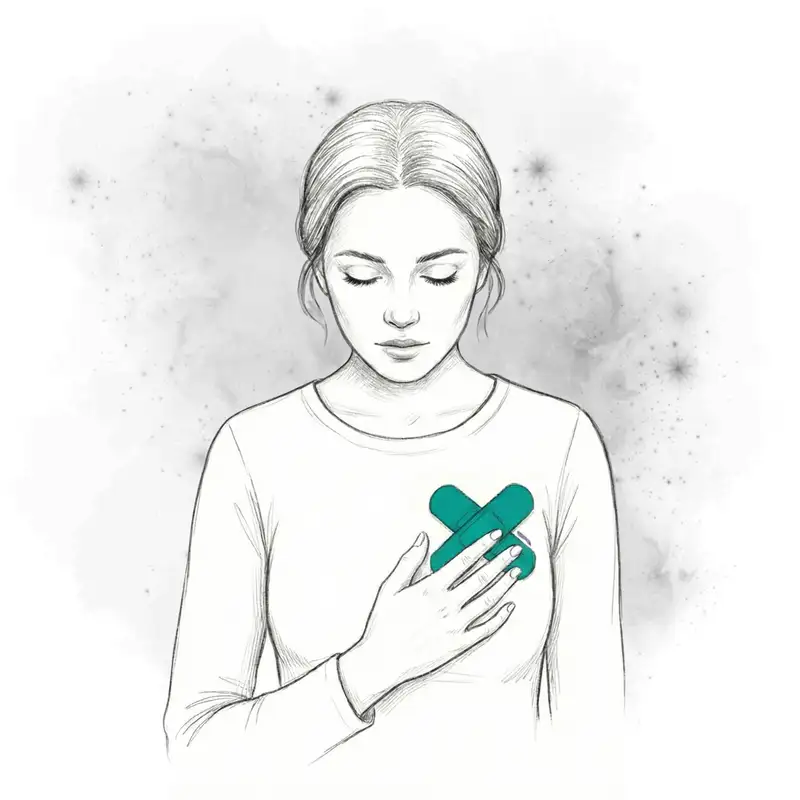
Shouldn’t I be past this? Healing evolves, not erases
FAITH: I've been thinking about the lie we tell ourselves about what it looks like to be healed. And there's this idea that healed means that the triggers no longer work.
MELODY: Okay. Tell me more?
FAITH: It's like a button doesn't exist anymore. The button that people used to press that would trigger me. I believe that healing means that button doesn't exist anymore. Or that I've put up enough protective barriers that nothing should get close enough to push it. And if it does, and I do get triggered, it means that all the work that I've done up to now was for nothing. And I have to start all over again.
MELODY: It kind of makes sense. Okay, let's talk about it in terms of... you're talking about healing, right? So you're healing from something. So in terms of like, if you heal from a sickness, say for example, a cough, it means that once you've healed from it, you're no longer coughing, right? So if you start coughing again, obviously the medication or the healing did not work.
FAITH: And that's a really good metaphor for it that I think we want to unpack a little bit, right after this. Welcome to Life in the Grey, a Mums At The Table podcast, where Melody and I grapple with the psychological factors that shape how we relate to others and ourselves. I'm Faith. I jump rope. I make content on the interwebs that intersect psychology and spirituality. And you can find most of my work on Instagram and Hope Channel Singapore.
MELODY: And I'm Melody. I jump rope badly. I'm a writer, a communicator, and project leader for Mums At The Table, the village it takes to raise a mum. Okay. So tell me a bit more.
FAITH: I believed I had reached a level of healing where nothing could shake me as bad as before. Yah. Zen. And then a routine conversation takes an unexpected turn. And the words that were said, the way they were said, suddenly my inner child is feeling all sorts of unsafe. It's like danger, danger. And even in the midst of the conversation, I could see myself desperately searching for safety. And I wish I didn't, but I did fall back into some of the old tragic patterns. Like what you said, it's like, I'm coughing again, right? I've got sickness, “sickness”, quote unquote, and I'm coughing again. And that further brought up more feelings of frustration because I started scolding myself. I'm telling myself, Faith, you've worked through this stuff. You've learned this. Why is this still getting to you? And if you are somehow letting them trigger you, then maybe the problem is not them. It's you. Something's wrong with you.
MELODY: I can totally relate to it in a different way. Let's talk about parenting and the fact that because as a parent, I always feel like I'm failing. And I think one of the important things is that there's this thing that I say, “I will not let my child trigger me. I will not lose my temper at him. I will not yell. I will be zen as well.” And then every time it comes around, it's like, clean your room or clean your teeth or something like that. And I'm yelling again, I'm losing my temper again. And yes, the feeling of failure is horrible.
FAITH: I do believe though, I guess I'm going to do a bit of a spoiler here in that healing is not about the erasure, but healing is about the evolvement. And I will explain what I mean by that because our bodies and our psyche do not do well with erasure. So when we talk about healing being evolving, I will go back to the story that I was sharing. And maybe this will explain what I mean by healing is evolving. Because even while it was happening, and even while there was a part of me that was freaking out, and another part of me that's scolding the freaked out part, there was also the adult version of me that's watching all of this and recognising, wow, okay, lots of chaos in the feelings bus. And whoever is driving this feelings bus right now wants to help, but they don't know how, so they can't drive this bus alone. And instead of asking, how do I get rid of this feeling? How do I kick them out of the bus? I asked instead, how can I offer comfort and safety while this feeling is learning to let go of the wheel while it's passing through?
MELODY: Well, I guess the fact that you could do that is already very indicative that you are actually healing. Because if you haven't healed, that adult version of you would never even have recognised that there's a bus.
FAITH: Perhaps this is the way that at least I deal with the feelings of failure in that I choose not to shame myself. It doesn't mean that I don't think about how I can do better the next time. But I think there's this two hands, like this balance, where on one hand, there is this offer of safety and assurance. And on the other hand, there is also this offer of how can we do things practically in a more regulated way, in a more helpful manner. And sometimes it's hard to do this, to think about the practical aspects of things, the practical changes we need to make, or the adjustments we need to make, if we don't first offer ourselves this self-compassion, this space to say, I am allowed to be scared. I'm allowed to be frustrated and angry. I'm allowed to feel this way. And I'm allowed also to feel like, yeah, I failed. I'm allowed to feel that I failed. And then when we allow these feelings to exist, now there is more space, there's more resources to then think, okay, so I've offered myself comfort and I feel much more comfortable right now. What practical steps can I take to make adjustments for the future? And I'm not thinking about the practical steps to try to add value to my worth. I'm thinking of the practical steps because this is the more effective way to move forward. This is the growth that I want. This is the choice that I make that's aligned with my boundaries, my values, my morals.
MELODY: There's two things that what you're saying is bringing up, right? And I hope I remember both of them. But the first one, right, is this analogy, metaphor? This thing, that you brought up to me. I think this was way back in our first few episodes, right? First few conversations. And it's about the fact that when it comes to triggers and our reactions, there is a highway and there is a bypass.
FAITH: The off-ramp?
MELODY: Yes, the off-ramp. And the reality is that it's very easy to get onto the highway. So whatever triggers us, even though we think that we are healed, the highway is still there. It doesn't mean that it's completely demolished. So it's definitely easier to get onto the highway than it is to get onto the off-ramp. But the reality is that once we've started healing, we can then find an off-ramp easier and faster, even though we know that we are on the highway. And I mean, to backtrack even, it's like we recognise that we are on the highway. That's healing in itself.
FAITH: Healing is not the erasure of the trigger. It is the evolvement of what we do with the trigger.
MELODY: And the recognition of where we are at the moment. The other thing, I remember, the other thing that I was thinking about, right, that you were talking about how the compassion and what it kind of spurs us into doing, is this difference between guilt and shame. So, you know, yes, we've done the wrong thing. We've gone onto the highway again, and we've reverted back to our old habits, old mistakes. And it's totally fine to feel guilt. Guilt is what helps us to do better next time. Guilt is going, you know what, you've kind of messed up there. But you can do better. What can we learn from this? And how can we change things next time? And that's fine. The problem is when it spirals into shame, and it becomes about your self-worth. It's like, oh, I've done the wrong thing. I've gone back into my old habit. I'm a terrible person. I will never be healed, ever. And that becomes about your self-worth. And it's like, oh, I will never be able to do this. I'm worthless. I don't have value. And that's a dangerous thing. And so, yes, the compassion needs to come in before guilt spirals into shame. But yeah, it's totally all right to feel guilt.
FAITH: Yeah. Here's another thing about shame. You use the word centres, right? It centres us, which means that when we have made mistakes, and notice I said when because we are human, when we make mistakes, what shame does, and this might be an uncomfortable statement for some people to hear, what shame does is it tricks us into thinking that we feel sorry. But what it is also doing is centring us in the narrative. So rather than looking towards the other person and saying, how can we repair? We are focusing on ourselves and our feelings and saying, I'm so bad. I'm so terrible. I'm just going to eat some worms in this corner. And then all of a sudden, other people need to handle our emotions for us. And that might be a difficult thing for some people to hear. I'm not judging anyone. I am not pointing fingers at anyone. I'm just saying this is probably a perspective that's not often seen. But it's something that I had to really go through myself and see, hey, this shame that I think is helping other people. It's actually not. It's actually just me and my ego.
MELODY: Yup. And I guess the other way I'm thinking about talking about how healing evolves is the fact that healing isn't a, you start from point A and then you end up in point B, step by step by step. It's more of three steps forward, one step back, two steps forward, another step back. It's going to happen. Sometimes you're going to go, yes, I've nailed it. This is it. I'm healed. But then there's going to be other times when you go, oh, no, I've reverted.
FAITH: It's all a journey. It's all a practise. What happens to us when we get triggered is not an indication of our level or our progress of healing to a certain extent. Let me explain myself clearer. What happens when we are triggered is also data telling me what I need to pay attention to. It doesn't mean we are healed or unhealed. If I'm triggered, I'm unhealed. If I'm not triggered, I'm healed. Healing is a journey. It's a process. You use steps. I like to use like a bundle of knots of many different strings that's all tied up together. It's like it's all over the place, right? It doesn't mean if we are triggered that we've lost all our progress. It just means we're still human. And healing isn't about never getting triggered. It's feeling the fear, the disappointment, the anger, the sadness, and still holding those feelings with kindness because they're trying to help us. And it's our job to figure out whether whoever is driving, what they want to do is what we actually want to do.
MELODY: Yes, I guess for me, in a sense, it's feeling like healing, we like to say we're talking about healing, right? But I think to a certain extent, another word for healing could be said that it's learning. We are still learning. And when you realise that you are still learning, you might have the ability to then access a lot more grace and compassion for yourself.
FAITH: Yes.
MELODY: So this question to our Life in the Grey community, right? How does healing look like to you? Has anything changed after hearing our conversation? Or maybe you want to share something about healing with us? Let us know in the comments or reach out to us by emailing hello@mumsatthetable.com or through any of the Mums At The Table socials. Life in the Grey is a monthly podcast brought to you by Mums At The Table. And with that, we'll catch you next month.
Creators and Guests